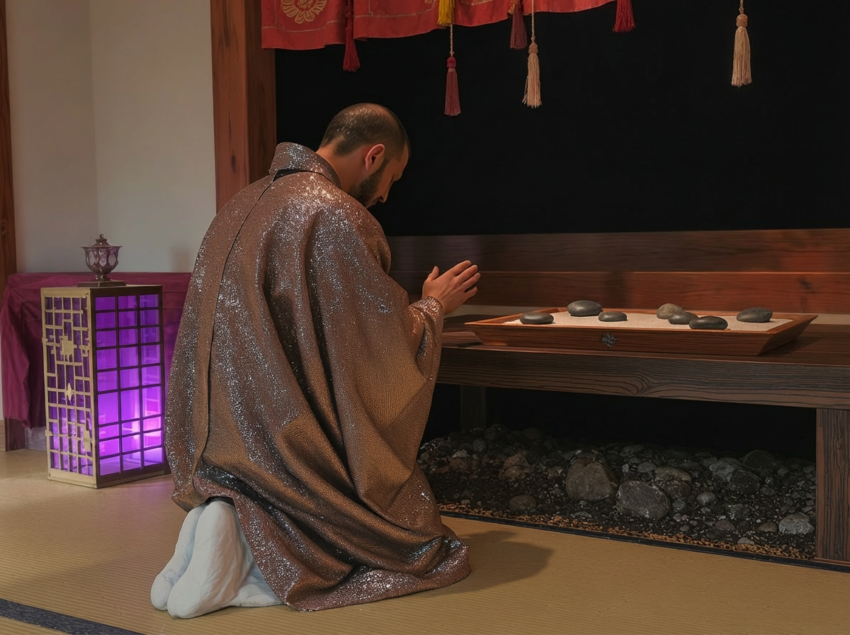
Daisuke meticulously wiped dust from the frame of the omoide-no-niwa, his family’s small rock garden shrine, taking care to not disturb the raked sand or the smooth pebbles nestled within. Today was auspicious: a new pebble would join the ancestors.
His wife Emi swept the tatami mats of the room, her eyes occasionally drifting to the reishin tablet on the altar with her father’s name, Kenji, and portrait on it. It was 20 years since he had died and everything he had ever recorded was stored in the AI inside the reishin, waiting to answer any question the family asked of it.
Today was the day for his memories to be cleaned, compressed, and added to the family’s ancestral wisdom. She wondered what would be left of him – his knowledge, his wisdom, his love of bad puns that always made her cringe.
But, she also knew it was time. His AI was starting to drift. Memories were starting to merge or were forgotten altogether. At times, responses rambled off to completely unrelated topics. It was time for his mitamakon, his digital “spirit”, to move to its final resting place with the family’s other ancestors.
Ren, their son, focused on the vitally important task of messaging his classmates at a rate achievable only by teens who were some place they didn’t really want to be.
[~~~]
As Daisuke and Emi finished their work, they heard three rhythmic knocks at the front door.
Opening the door revealed two men in ceremonial robes.
The younger man, standing in the front and in a less formal robe, bowed and introduced himself.
“Good morning. I am Gishi Sato. I will be handling the technical parts of today’s ceremony. This is the Master of the Rite,” he turned, bowing, and motioned toward the older man standing behind him in a robe of shimmering material that twinkled in the morning sun.
Daisuke welcomed them in and led them to the main room of the house, where the family shrine was located.
As the priest knelt in front of the shrine, Sato set down the dark case he was carrying and bent to open it. He pulled out four extending poles and set them in a square surrounding the shrine and the priest. Then, he withdrew three curtains of metallic gossamer threads from the case.
“These will protect your father’s mitamakon from any outside interference as it moves to its final resting place,” he told the family, showing them the curtains.
Sato connected the curtains to the poles, forming a Faraday cage for the ceremony. Then he pulled a jar out of the case, knelt down, and passed it through the threads of the curtain, to the waiting priest.
While starting a prayer in a low monotone whisper, the priest opened the jar, grabbed a handful of white crystals from inside it, and scattered them around the curtained-off area.
“This salt removes any surrounding static or ionic interference, ensuring an undisturbed transfer,” Sato said.
Sato retrieved a wand with thin fiber-optic strands and passed that to the priest. It looked like a worn out paintbrush, or a horse’s tail.
The priest began a new almost-inaudible chant and waved the wand around the area surrounded by the curtains. His motions had a pattern to them that ensured the wand would cover every direction, and every corner, of the space.
“The Master is checking for any interference. If there is any, the filaments will change color, and we would need to do a deeper cleanse.”
When every corner was checked, the priest thoroughly inspected the fibers of the wand. After a minute, he turned to face Sato, slowly nodded, and passed the wand back to him.
“The filaments are clear. The space is pure and will be undisturbed,” Sato said. “We can begin to move your father’s spirit.”
[~~~]
Sato removed a black lacquer tray from his case and passed it to the priest with both hands. The priest set it on the floor in front of him, squaring it up between himself and the shrine.
Sato next retrieved a box from his case. It was covered with Urushi lacquer, and showed wear from years of use. He passed the box, still using both hands, to the priest.
The priest placed it on top of the tray and opened it. The interior was raw, unfinished Hinoki wood, with two indentations carved into it.
The priest collected the reishin from the shrine and placed it into the larger of the boxes’ indentations.
Sato opened something, still in his case and found what he needed. It looked like a black river pebble, but everyone present knew it was the future, and final, home of Kenji’s mitamakon. Sato passed the ishigokoro, the pebble, to the priest who placed it in the smaller, round indentation in the box.
“As a tree needs its branches pruned, in order to stay healthy, a spirit needs its kegare removed to let its essence shine.”
Ren’s suddenly became attentive and his brow furrowed.
“Do you have a question?,” Sato asked.
“Is my grandfather going to forget me? He died before I was born. If you reset his memory, he won’t even know I exist.”
“Don’t worry. Your grandfather’s memory is not being reset. He will remember the stories of your birth – how happy and proud your parents were. But, he won’t be able to tell you what the temperature was on that day. He will remember being told about your first word, your first step, all the big things of your life. He will also remember the important conversations you had with him while he was in his reishin. And, with the incidental memories pruned, he will be more like himself than you have probably seen lately.”
Emi reached over and squeezed Ren’s hand. “It will be OK. I worried about the same thing when my grandmother was moved. But, I can still sense her when I speak with the omoide-no-niwa. Her spirit is still in there, with our other ancestors.”
Ren looked at his grandfather’s stone, sitting in the transfer box, then to the garden with the rest of his ancestors. The pebbles already in the garden held the memories of other family members he’d never met, but that he had spoken with at times.
Ren exhaled a small sigh and nodded to no one in particular.
Sato turned to the priest and bowed slightly.
The priest clapped twice and uttered Kenji’s name. His image on the reishin began to glow.
“Now, we will begin the cleansing and move,” Sato informed the family as he reached in his robe and pulled out a small digital tablet.
The priest started a low rhythmic hum. A warm blue light started to glow in the transfer box, barely visible through the wood, pulsing from the reishin to the ishigokoro.
Sato’s tablet displayed a progress indicator, slowly growing. The error counter showed an unchanging zero.
After a few minutes, the tablet showed the move was complete, with no errors reported on Sato’s tablet.
The priest stopped his chant. The ishigokoro now displayed Kenji’s name and birth date in a warm yellow glow, while the reishin was now blank.
Sato turned off his tablet and returned it to his robe’s interior pocket. He retrieved a small wooden rake and a silk cloth from within his case and passed them to the priest.
“Now, the Master will place your father with your other ancestors. He will arrange the sand so they can all speak with one voice.”
The priest laid out the silk cloth on the lacquered tray, placed the rake at the edge, and removed the existing pebbles from the ancestors’ garden, placing them on the silk cloth. He took Kenji’s pebble from the transfer box and placed it alongside the others on the cloth.
He then took the rake and flattened all the sand within the garden, creating a blank slate for the updated family of ancestors.
For a few minutes, the priest looked in silence between the pebbles before him and the empty garden.
Finally, the priest selected the one with the oldest birth date on it and placed it in the garden, lightly pressing it into the sand. He repeated that for each pebble, placing them in a pattern whose rules were only visible to him.
When there were no pebbles left, he took the rake and formed rings around each pebble. When those were finished, he used the rake to make flowing pathways between each stone. He looked at the garden for a moment, to ensure everything would flow properly. This was an important step as the sand was more than just sand. It was silicon that the ishigokoro used to transfer data between each other.
Satisfied, the priest raked a border around the garden, in one unbroken motion, then set the rake back down on the silk cloth.
“Now, the Master will make sure your ancestors are joined in unison.”
The priest clapped twice. The sand in the garden glowed, with even brightness in all spots.
The priest asked the garden, “Do the waters flow as one?”
In a harmonic resonance, made up from several voices, the garden replied, “The river bed is stable. The water is clean and flows freely to all places. We are one.”
“Your father has joined with your other ancestors. His wisdom will be present when you have need to speak to them,” Sato told the family.
With that, Sato quietly and efficiently reloaded the ceremonial equipment into his case. He and the priest exchanged bows with the family and took their leave.
[~~~]
Later that night, Emi sat, holding her father’s now-empty reishin and looking at her family omoide-no-niwa.
The ceremony, and everything it meant, weighed on her more than she had expected. It almost felt like losing her father a second time.
She checked her watch. Her mind wouldn’t let her sleep – too many thoughts running through it. But, her body was telling her she was done with the day.
Emi stood and placed the blank reishin on a shelf next to the family shrine. She stretched her arms above her head, to release the tension of the day.
“It’s been a long day, and I’m tired.” She paused and gave her father’s ishigokoro one last look. “Good night, dad.”
As she walked away, the sand of the garden glowed faintly.
In a soft, layered thrum, the garden replied, “Good night, Tired.”